
Smart controls can make a heat pump easier to use and may help it respond more intelligently to changing weather, room temperatures, electricity tariffs and household routines. Two systems attracting attention are the Passiv Smart Thermostat: formerly sometimes referred to as the Passiv Smart Controller: and Adia Thermal.
They take different approaches. Passiv focuses mainly on heat-pump operation and energy management, while Adia Thermal focuses on room-by-room heat distribution and predictive hydraulic balancing. Neither is automatically the right choice for every home.
The best control system depends on the property, the heat pump, the radiators or underfloor heating, the wiring and the way the complete system has been designed. That is why a survey should come before selecting controls.
Why smart controls matter for a heat pump
A gas or oil boiler can raise water to a relatively high temperature quickly. Heat pumps are different. They generally work most efficiently when they provide a steady supply of lower-temperature water over longer periods.
This makes the relationship between the heat pump, heating emitters, controls and building fabric particularly important.
A well-designed control system can help manage:
- Flow temperature: the temperature of water sent to radiators or underfloor heating
- Weather compensation and changing outdoor conditions
- Room temperatures and heating schedules
- Domestic hot water production
- Solar generation and time-of-use electricity tariffs
- The distribution of heat around the property
- System performance and fault information
However, smart controls cannot correct every design problem. If a room has an undersized radiator, poor insulation or restricted pipework, adding an app or thermostat will not automatically solve the underlying issue.
Our heat pump installation service starts with the property and its heating requirements, rather than a particular manufacturer or control platform.
Passiv Smart Thermostat: heat-pump operation and energy management
The Passiv Smart Thermostat is designed specifically around heat-pump operation. It combines an in-home thermostat and programmer with an app and installer monitoring portal.
Its main role is to help determine how and when the heat pump should operate.
Learning how the property heats and cools
The system can monitor how quickly a home responds to heating and how long it retains warmth. This information can then be used to adjust operation more gradually, rather than relying only on a basic on/off thermostat.
This approach is relevant to heat pumps because steady, lower-temperature operation can be preferable to frequent, high-output cycles. The results will depend on the building fabric, emitter sizing, weather, household behaviour and the original system design.
Weather-aware and flow-temperature optimisation
The Passiv Smart Thermostat can use local weather information and property data to adjust the heat pump’s flow temperature. In a compatible installation, this can reduce the need for an installer to set a fixed weather compensation curve directly on the heat pump.
The aim is to provide enough heat for the property without unnecessarily raising the water temperature.
Passiv states that its system can help improve comfort and energy performance, but these should be treated as potential outcomes rather than guarantees. A heat pump’s actual efficiency depends on its seasonal operating conditions, flow temperatures, system volume, defrosting, hot water requirements and maintenance.
Smart preheating, tariffs and solar
Passiv can also take account of time-of-use electricity tariffs and solar photovoltaic generation. For example, it may be possible to preheat a home during a lower-cost period or make better use of available solar electricity.
That does not mean every home will benefit from changing its heating schedule. Preheating must be considered alongside comfort, the building's thermal mass, and the household’s actual tariff. A suitable control strategy should reduce unnecessary complexity, not make the homeowner constantly manage the system.
The Passiv app provides remote control, scheduling and access to heating and hot water information. Its installer portal can also allow remote monitoring of system performance, which may help identify unusual temperatures, settings, or fault conditions without an immediate site visit.
For current product information, see the Passiv Smart Thermostat page.

Adia Thermal: room-by-room heat distribution
Adia Thermal takes a different approach. Rather than focusing primarily on the heat pump’s operating logic, it is designed to manage heat distribution through an existing wet heating system.
It combines:
- An Adia Hub
- Electronic Flow Balancing Valves
- Wireless Ambient Temperature Sensors
- An Adia app
The system is intended to help manage radiator-based retrofit installations by measuring conditions in individual rooms and adjusting the flow through each radiator.
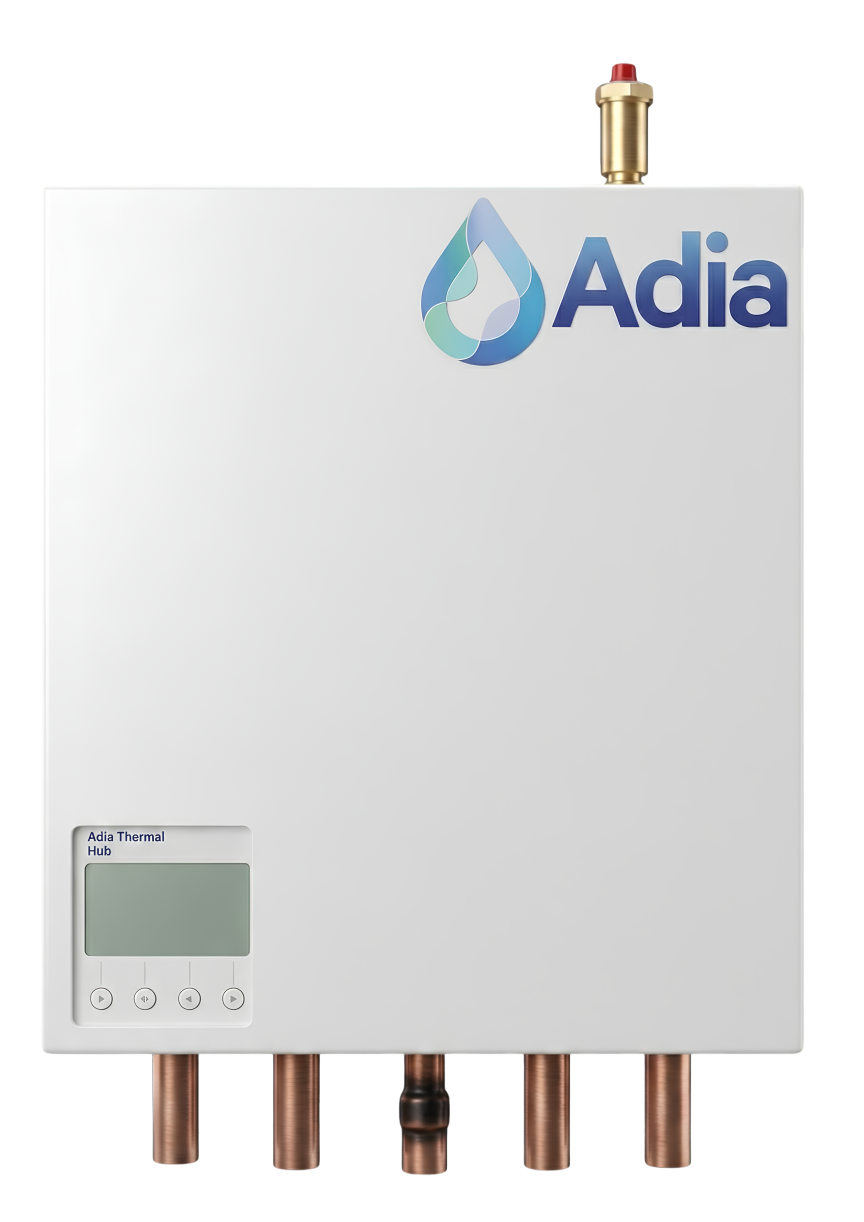
The Adia Hub
The Hub acts as the central control and hydraulic interface. It sits between the heat pump and the property’s heating system, coordinating the heat pump, room sensors and electronic valves.
Depending on the system design and compatibility, it can help manage flow temperature, heating operation and domestic hot water switching.
The Hub communicates with connected components through its own wireless network and may communicate with compatible heat pumps using Modbus. The exact requirements need to be checked for the selected heat pump and installation.
Room sensors and flow-balancing valves
Adia’s room sensors measure conditions in individual heated rooms. The electronic flow-balancing valves are fitted to radiator or towel-rail circuits and can regulate the amount of hot water flowing through each emitter.
In simple terms, the system is intended to send more heat where it is needed and restrict flow where a room is already warm.
This can be useful in retrofit properties where different rooms have different levels of insulation, solar gain, radiator output or pipework resistance. The system is designed to learn how rooms respond and use that information to make adjustments over time.
Adia’s published information describes this as predictive hydronic balancing. Its case studies and performance figures are supplier-reported examples, not guaranteed results for every customer.
Can Adia Thermal keep all your existing radiators?
This is an important question for homeowners replacing an oil, LPG, electric or gas heating system.
Adia Thermal is intended to support existing radiator systems, but that does not mean every property can retain every radiator or section of pipework without changes.
Suitability still needs to be confirmed through:
- Room-by-room heat-loss calculations
- Existing radiator output checks at the proposed flow temperatures
- Pipework and circulation assessment
- System condition and water-quality checks
- Hot water cylinder and domestic hot water requirements
- Heat pump sizing and operating-temperature assessment
A radiator that provides adequate heat with a boiler at a high flow temperature may not provide enough output at the lower temperatures preferred by a heat pump. In some rooms, a larger radiator, an additional emitter, or insulation improvements may still be sensible.
Adia may help distribute available heat more effectively, but it cannot create heat output that an undersized emitter or poorly insulated room does not have.
Passiv and Adia Thermal compared
The simplest way to understand the difference is:
| Control approach | Main focus | Typical questions it addresses |
|---|---|---|
| Passiv Smart Thermostat | Heat-pump operation and energy management | What flow temperature is needed? When should the heat pump run? Can operation respond to weather, tariffs or solar generation? |
| Adia Thermal | Room-by-room distribution and hydraulic balancing | How much flow does each radiator need? Which rooms are warming quickly or slowly? How can the system respond to different room conditions? |
There can be some overlap. Both systems may interact with the heat pump, control heating operation and use data to optimise performance.
They should not, however, be assumed to work together automatically. Compatibility, wiring, communications protocols and overall system architecture must be checked before either is specified. In some installations, using two independent control systems could create conflicting commands or complicate commissioning.
An installer should confirm which device is responsible for flow-temperature control, room temperature control, hot water operation, tariff response and safety functions.
Why a survey should come before smart controls
A smart control system is only as useful as the information and design behind it.
At Clima Renewables, a survey-led assessment can consider the whole property, including:
- Room dimensions and construction
- Insulation and glazing
- Ventilation and air leakage
- Design heat loss for each room
- Existing radiator or underfloor heating output
- Pipework routes and hydraulic restrictions
- Heat pump location and system capacity
- Hot water usage
- Control and communications requirements
A heat loss survey helps establish how much heat each room needs on a cold design day. This is more useful than choosing a control based solely on the number of zones or the appearance of an app.
Thermal imaging can provide additional evidence of cold spots, insulation gaps and air leakage. Clima’s thermal imaging survey is particularly useful when assessing older or retrofit properties, although infrared images should be interpreted alongside construction details and heat-loss calculations.

Are smart controls suitable for oil and LPG property upgrades?
Smart controls can be considered when replacing an oil or LPG boiler with a heat pump, particularly in rural and off-gas-grid homes across Northamptonshire, Cambridgeshire and Bedfordshire.
The control system should be selected as part of the complete design. The existing radiators, pipework, cylinder, electrical supply and insulation all need to be assessed.
Eligible homeowners may also be able to apply for support through the Boiler Upgrade Scheme, subject to current scheme rules, property requirements and installer eligibility. The grant does not remove the need for a proper design or guarantee that a particular control system will be suitable.
Frequently asked questions
Is the Passiv Smart Thermostat the same as Adia Thermal?
No. Passiv primarily focuses on heat-pump operation and energy management. Adia Thermal focuses more on room-by-room heat distribution and predictive hydraulic balancing.
Can I use Passiv and Adia Thermal together?
Possibly, but not automatically. The installer must check compatibility, wiring, communications, heat-pump integration and which system will control each function.
Will smart controls make any heat pump more efficient?
Not necessarily. Controls may help a correctly designed system operate more appropriately, but performance depends on heat-loss calculations, heat-pump sizing, flow temperatures, emitter output, hydraulics, insulation and how the home is used.
Can I keep my existing radiators?
Some properties may retain many or all of their existing radiators, but this must be confirmed. Each radiator should be checked against the room’s calculated heat loss and the heat pump’s proposed flow temperature.
The right control starts with the right design
Passiv Smart Thermostat and Adia Thermal represent two different ways of improving heat-pump control.
Passiv is centred on heat-pump operation, weather-aware flow-temperature management, smart preheating, tariffs, solar and installer monitoring. Adia Thermal is centred on room-by-room sensing and distributing heat through radiators and pipework.
The important question is not which product is universally best. It is which approach, if any, fits the property and the complete heating system.
If you are considering a heat pump or upgrading from oil or LPG, contact Clima Renewables to book a survey. We can assess the building, emitters and system requirements before recommending suitable controls.